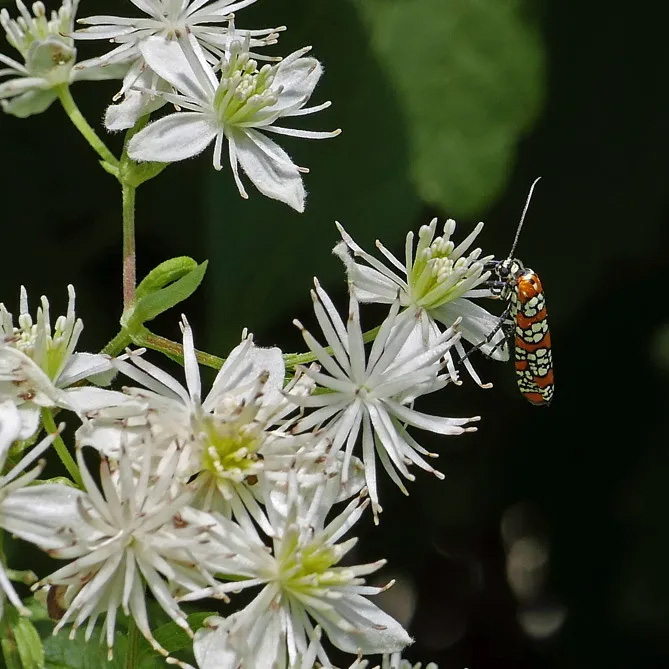
Looking for a native vine that brings late-summer beauty and wildlife value to the landscape? Meet Virgin’s Bower (Clematis virginiana), a vigorous native clematis covered with clusters of delicate white flowers in late summer. As the flowers fade, they are replaced by distinctive feathery seed heads that give the plant another common name—Old Man’s Beard.
Virgin’s Bower grows naturally along woodland edges, streambanks, thickets, and other moist areas. Give it a fence, trellis, arbor, or other sturdy support and room to climb. Its flowers attract a variety of pollinating insects, while its dense foliage can provide cover for birds and other wildlife.
🦋 AN IMPORTANT MOTH CONNECTION
Virgin’s Bower is also an important larval host plant for the Clematis Clearwing Moth (Alcathoe caudata). This fascinating moth is a master of disguise: like many clearwing moths, its appearance resembles a wasp more than the fuzzy moth we might expect. Its connection to Virgin’s Bower is especially close—the larvae bore into the vine’s stems and roots as they develop, and local populations depend heavily on native clematis for successful reproduction.
🌱 This is a wonderful example of why native plants matter. Planting Virgin’s Bower isn’t simply adding a beautiful flowering vine. You’re adding another link to the food web and providing habitat for an insect whose life cycle is closely connected to this native plant.
Plant the native plant. Support the insect. Strengthen the ecosystem. 🌿🐛🦋
Photo: Master Gardeners of Northern Virginia
#VirginsBower #ClematisVirginiana #ClematisClearwingMoth #NativePlants #NativeVines #Pollinators #HostPlants #PlantNative #WildlifeGarden #HabitatAtHome