Did you know that one native wildflower can support two very different pollinators in two very different ways?
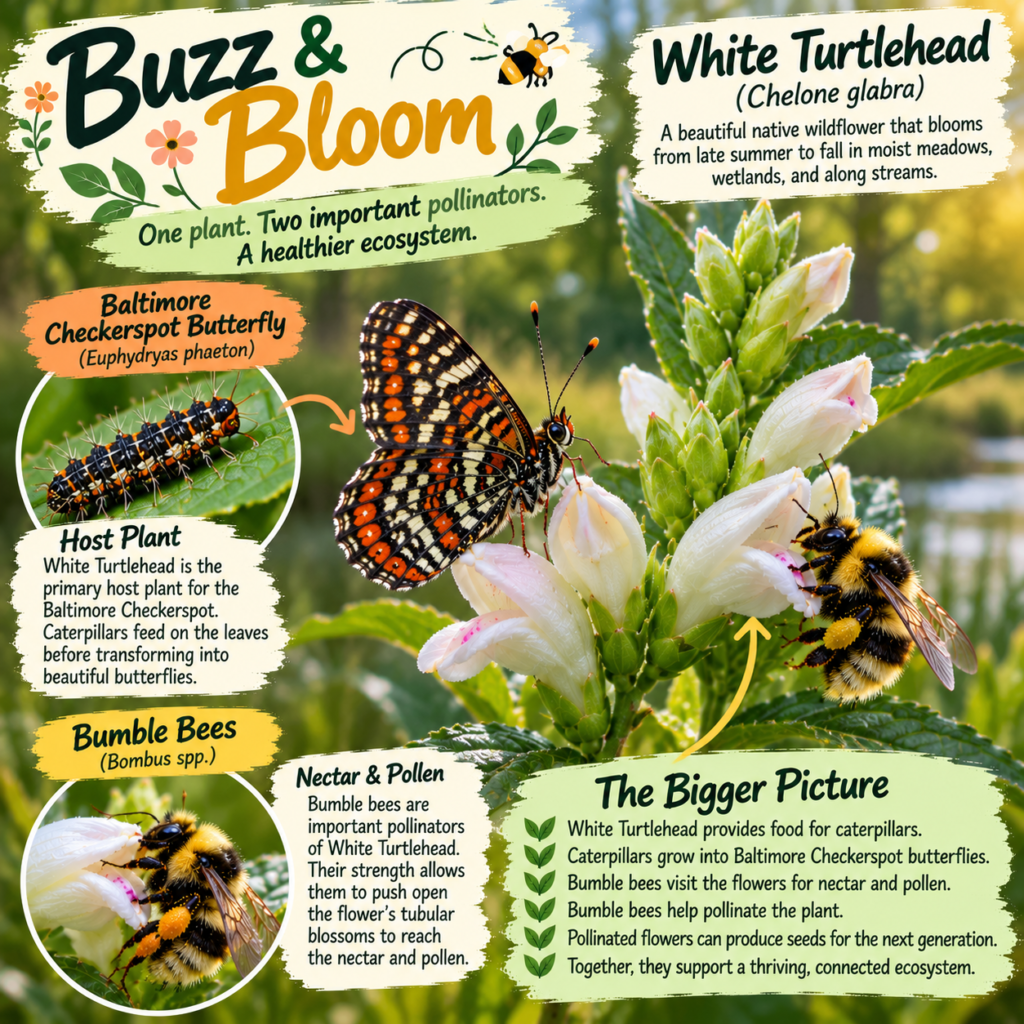
Meet White Turtlehead (Chelone glabra), a beautiful native wildflower with unusual white blossoms that resemble tiny turtle heads. This moisture-loving plant plays an important role in the lives of both the Baltimore Checkerspot butterfly and our hardworking bumble bees!
🌿 THE BLOOM: White Turtlehead (Chelone glabra)
Found naturally in wetlands, moist meadows, and along streams, White Turtlehead produces distinctive white flowers from late summer into fall.
But those beautiful blossoms are only part of the story!
White Turtlehead provides:
🌸 Nectar and pollen for visiting bumble bees.
🐛 Leaves that nourish Baltimore Checkerspot caterpillars.
🌱 Valuable plant diversity in moist native habitats.
🦋 THE BUTTERFLY: Baltimore Checkerspot (Euphydryas phaeton)
For the Baltimore Checkerspot, White Turtlehead is much more than a flower—it’s a nursery!
Female butterflies lay clusters of eggs on the leaves of White Turtlehead.
When the eggs hatch, the young caterpillars begin feeding on the foliage, often gathering together inside protective silk webs.
As autumn approaches, the caterpillars enter a period of dormancy, overwintering before resuming development in spring.
Without suitable host plants, the next generation of Baltimore Checkerspots cannot survive.
🐛 The connection:
White Turtlehead → Caterpillar → Baltimore Checkerspot Butterfly
🐝 THE BUZZ: Bumble Bees (Bombus spp.)
While Baltimore Checkerspot caterpillars depend on the leaves, bumble bees are busy visiting the flowers!
White Turtlehead blossoms have a fascinating structure. Their tightly closed, tubular flowers require a strong visitor to push open the petals and reach the nectar inside.
💛 Bumble bees are perfectly suited for the job!
As they squeeze into the flowers, they collect nectar and pollen while transferring pollen between blossoms.
This relationship benefits both partners:
🐝 The bumble bee receives food.
🌸 The flower receives help with pollination.
It’s a wonderful example of how native plants and native pollinators have developed specialized relationships over time.
🌎 THE BIGGER CONNECTION: ONE PLANT, MULTIPLE LIVES
🌿 White Turtlehead provides food for caterpillars.
🦋 Caterpillars develop into Baltimore Checkerspot butterflies.
🐝 Bumble bees visit the flowers for nectar and pollen.
🌸 Bumble bees help pollinate the plant.
🌱 Pollinated flowers can