Have you ever wondered how plants travel when they don’t have legs, wings, or feet?
From seeds that parachute through the air to seed capsules that explode like tiny catapults, plants have developed some truly remarkable ways to send their offspring out into the world.
This week’s Explore Outdoors Nature Challenge invites you to become a Seed Dispersal Detective and discover the fascinating ways native plants spread their seeds!
🌱 Why Do Seeds Need to Travel?
Seed dispersal helps plants:
- Find new places to grow.
- Reduce competition with their parent plants.
- Reach suitable sunlight, soil, and moisture conditions.
- Establish new plant populations.
- Restore and expand natural habitats.
Nature has developed an incredible variety of strategies to accomplish this important task.
🔍 Your Mission: Discover Six Seed Dispersal Strategies!
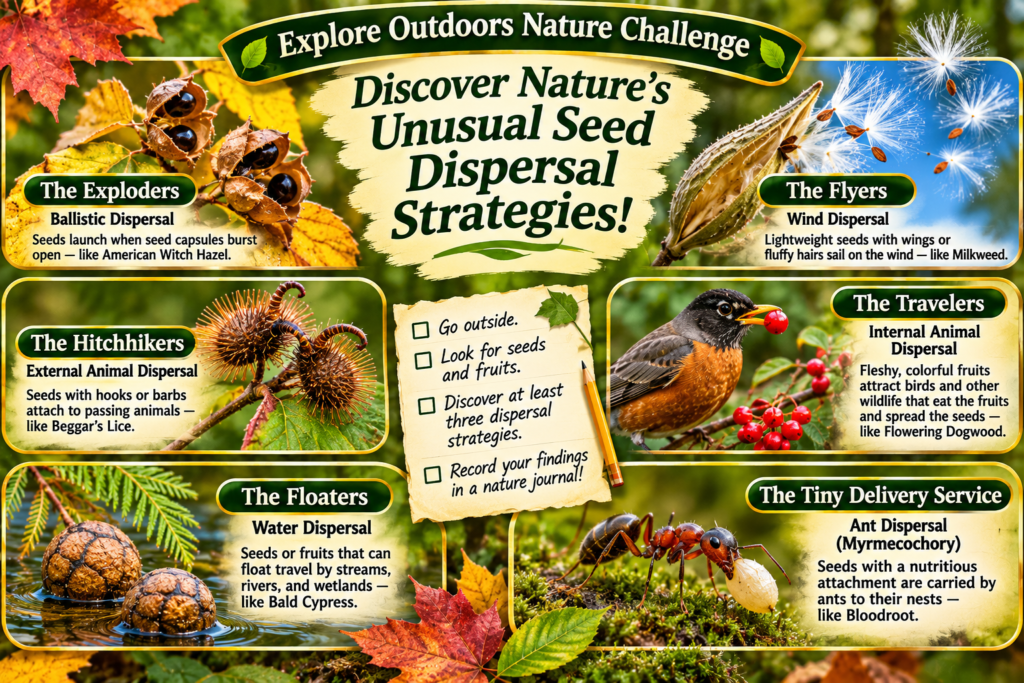
💥 1. The Exploders — Ballistic Seed Dispersal
Some plants launch their seeds by building pressure inside their seed capsules until they suddenly burst open.
Our featured native plant this week, American Witch Hazel (Hamamelis virginiana), can propel its seeds several feet away from the parent plant!
Other native examples include:
- Spotted Jewelweed
- Wild Geranium
- Violet species
Your challenge: Search for dried seed capsules. Can you find evidence of a capsule that has already burst open?
🌬️ 2. The Flyers — Wind Dispersal
Some seeds have fluffy parachutes, wings, or lightweight structures that allow them to travel on the wind.
Native examples include:
- Milkweed
- Goldenrod
- Asters
- Red Maple
- Tulip Poplar
Your challenge: Find a seed with wings or fluffy hairs. Observe how its shape helps it travel through the air.
🐕 3. The Hitchhikers — External Animal Dispersal
Some seeds and fruits have tiny hooks, barbs, or sticky surfaces that allow them to attach to passing animals — or even your clothing!
Native examples include:
- Beggar’s Lice (Desmodium species)
- Tickseed Sunflower
- Cocklebur
Your challenge: Examine your socks and clothing after a nature walk. Did any seeds hitch a ride?
🐦 4. The Travelers — Internal Animal Dispersal
Many native plants produce colorful, fleshy fruits that attract birds and other wildlife. Animals eat the fruits and may deposit the seeds in new locations through their droppings.
Native examples include:
- American Beautyberry
- Flowering Dogwood
- Northern Spicebush
- American Holly
- Winterberry
Your challenge: Search for native plants with fruits. Observe whether birds are visiting them.
💧 5. The Floaters — Water Dispersal
Some plants produce seeds or fruits that can travel through streams, rivers, wetlands, and floodwaters.
Native examples include:
- Bald Cypress
- Buttonbush
- Swamp Milkweed
Your challenge: Explore a streambank, pond edge, or wetland from a safe location. Look for seeds or fruits that may have been transported by water.
🐜 6. The Tiny Delivery Service — Ant Dispersal
Some native woodland wildflowers produce seeds with a nutritious attachment called an elaiosome.
Ants carry these seeds back to their nests, consume the nutritious attachment, and discard the seeds, sometimes in locations suitable for germination.
This fascinating partnership is known as myrmecochory.
Native examples include:
- Bloodroot
- Trillium
- Wild Ginger
- Violet species
Your challenge: Look for ants along the woodland floor. Imagine how these tiny creatures help shape the forests around us!
📝 Become a Seed Dispersal Detective
Bring along a nature journal, hand lens, camera, and pencil.
For each seed or fruit you discover, record:
- The plant’s name, if known.
- The seed’s shape, size, and color.
- Any wings, hairs, hooks, or other special features.
- Where you discovered it.
- How you think it travels.
Can you discover examples of at least three different seed dispersal strategies?
🌟 Bonus Challenge: Design Your Own Super Seed!
Imagine you are a native plant that needs to send its seeds to a new location.
Would your seeds have wings, parachutes, hooks, floating structures, or an explosive launching mechanism?
Draw your imaginary seed and explain how its special adaptations would help it travel.
Invite your family to design their own seeds and compare your creative inventions!
📸 Become a Citizen Scientist
Photograph the seeds, fruits, and plants you discover and share your observations on iNaturalist.
Remember to observe responsibly. Leave seeds in their natural habitats, avoid spreading invasive plants, and obtain permission before collecting any plant materials.
Never eat unidentified seeds or fruits.
💚 The Bigger Picture
Seed dispersal is about much more than helping individual plants reproduce. It helps maintain biodiversity, connect habitats, restore damaged ecosystems, and ensure that future generations of plants continue to support wildlife.
From a tiny ant carrying a woodland wildflower seed to a bird spreading the seeds of a native shrub, nature’s living tapestry is constantly growing and expanding.
The next time you discover a seed, take a closer look. You may be holding one of nature’s most remarkable inventions!
Explore Outdoors. Discover Nature’s Traveling Seeds. Celebrate the Journey!
🌿 Nature on the Brink
Inspiring the Next Generation of Environmental Stewards
Explore. Discover. Connect. Protect.
#NatureOnTheBrink #ExploreOutdoors #NatureChallenge #SeedDispersal #SeedDetective #AmericanWitchHazel #BallisticSeedDispersal #NativePlants #NatureExploration #OutdoorLearning #CitizenScience #WoodlandHabitats #NatureEducation #Biodiversity #PlantNative