Did you know that one beautiful native wildflower can help support an entire butterfly life cycle?
Meet the Black Swallowtail (Papilio polyxenes), a striking butterfly whose survival depends on plants that provide food for its caterpillars.
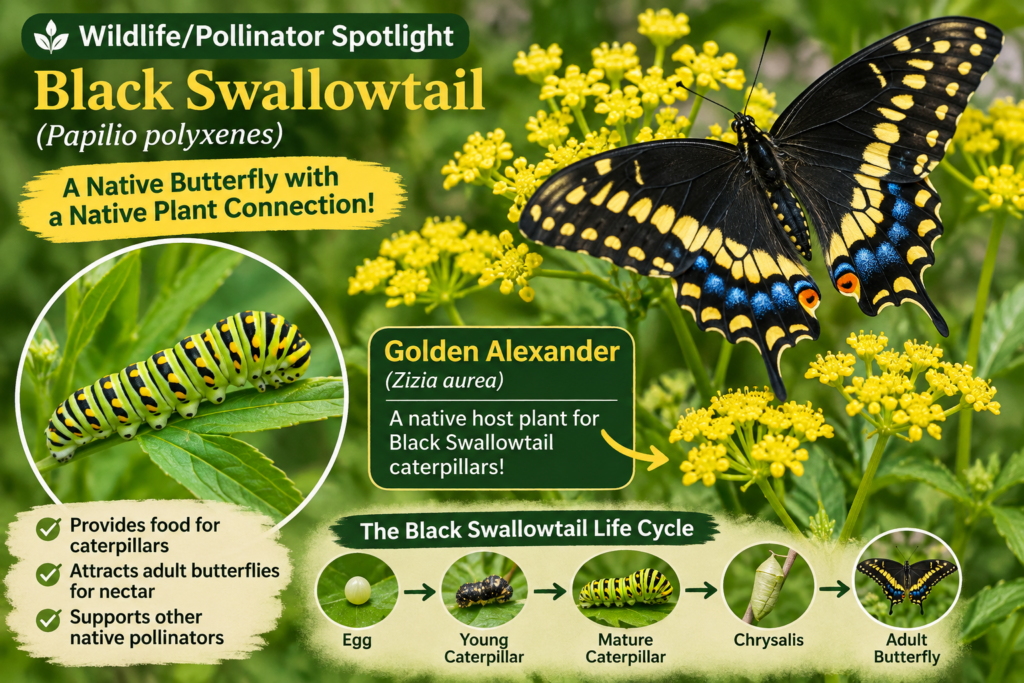
One of those important native host plants is Golden Alexander (Zizia aurea)!
This fascinating relationship reminds us that creating butterfly habitat means providing more than flowers for adult butterflies. We must also feed their caterpillars!
🦋 MEET THE BLACK SWALLOWTAIL!
The Black Swallowtail, sometimes called the Eastern Black Swallowtail, is a familiar sight in gardens, meadows, and open habitats throughout much of North America.
🔎 How to Recognize One:
🦋 Wings: Predominantly black with rows of yellow spots and beautiful blue markings along the hindwings.
💙 Females: Often display more prominent blue markings and reduced yellow bands compared with males.
🧡 Distinctive Markings: Orange eyespots near the tails of the hindwings.
📏 Wingspan: Approximately 2½–4 inches.
🌸 Adult Diet: Nectar from flowering plants, including native wildflowers.
But the butterfly’s story begins long before it takes flight!
🐛 MEET THE CATERPILLAR: A COLORFUL GARDEN VISITOR!
Black Swallowtail caterpillars undergo a remarkable transformation as they grow.
🥚 Egg: A female butterfly lays tiny, pale yellow eggs individually on suitable host plants.
🐛 Young Caterpillar: Newly hatched caterpillars are dark with a white band, resembling bird droppings—a clever form of camouflage!
💚 Older Caterpillar: As they mature, they develop striking green bodies with black bands and yellow-orange spots.
🌿 Feeding: Caterpillars consume the leaves and tender growth of their host plants, storing energy for their transformation.
🦋 Chrysalis: When fully grown, the caterpillar forms a chrysalis, where it transforms into an adult butterfly.
✨ Adult Butterfly: The butterfly emerges, expands and dries its wings, and begins searching for nectar and potential mates.
🌼 THE GOLDEN ALEXANDER CONNECTION
Golden Alexander (Zizia aurea) is a native member of the carrot family (Apiaceae), the same plant family that includes parsley, dill, fennel, and carrots.
For Black Swallowtails, this botanical connection is especially important!
🌱 Female butterflies recognize suitable host plants and lay their eggs on them.
🐛 Caterpillars hatch and feed on Golden Alexander’s foliage.
🦋 After completing their development, they become adult butterflies that visit flowers for nectar.
🌼 Golden Alexander’s spring blooms also provide floral resources for small native bees, flower flies, and other beneficial insects.
One native plant can support multiple species and different stages of an insect’s life!
🧡 A REMARKABLE DEFENSE: THE CATERPILLAR’S SECRET WEAPON!
Have you ever seen a Black Swallowtail caterpillar extend two bright orange, horn-like structures from behind its head?
That’s its osmeterium!
When threatened, the caterpillar can extend this forked, scent-producing organ to discourage predators.
It’s one of nature’s fascinating defensive adaptations!
🌿 WHY HOST PLANTS MATTER
Adult butterflies may visit many different flowers for nectar, but their caterpillars often depend on a much smaller selection of plants.
Without suitable host plants, butterflies cannot successfully reproduce.
That’s why planting native species like Golden Alexander is so valuable.
By including native host plants in our landscapes, we can:
🐛 Provide food for developing caterpillars.
🦋 Support butterfly reproduction.
🌼 Offer nectar and pollen resources for other beneficial insects.
🐦 Strengthen the food web by supporting insects that birds and other wildlife depend on.
🌎 Increase biodiversity in our gardens and communities.
🏡 YOUR WILDLIFE/POLLINATOR CHALLENGE!
This week, look beyond the flowers in your garden!
🔎 Search for butterfly eggs or caterpillars on suitable host plants.
🌱 Consider planting Golden Alexander in your native plant garden.
🐛 If you discover caterpillars eating your plants, let them feed! Those chewed leaves may be evidence of a thriving wildlife habitat.
📸 Photograph a caterpillar and observe how its appearance changes as it grows.
🌼 Remember to provide both host plants for caterpillars and nectar plants for adult butterflies.
💚 THE BIGGER PICTURE
The Black Swallowtail and Golden Alexander share an important ecological relationship.
Golden Alexander provides food for the butterfly’s developing caterpillars, helping make the next generation of Black Swallowtails possible.
And those caterpillars become part of a larger food web that supports birds and other wildlife.
A garden full of flowers may attract butterflies. A garden with host plants helps create butterflies!
🌼 Plant Golden Alexander. Welcome the caterpillars. Protect the butterflies. Grow a healthier ecosystem! 🐛🦋
#WildlifePollinatorSpotlight #NatureOnTheBrink #BlackSwallowtail #PapilioPolyxenes #GoldenAlexander #ZiziaAurea #ButterflyHostPlants #NativePlants #CaterpillarConservation #ButterflyLifeCycle #PollinatorHabitat #NativePlantGardening #WildlifeHabitat #Biodiversity #PlantNative