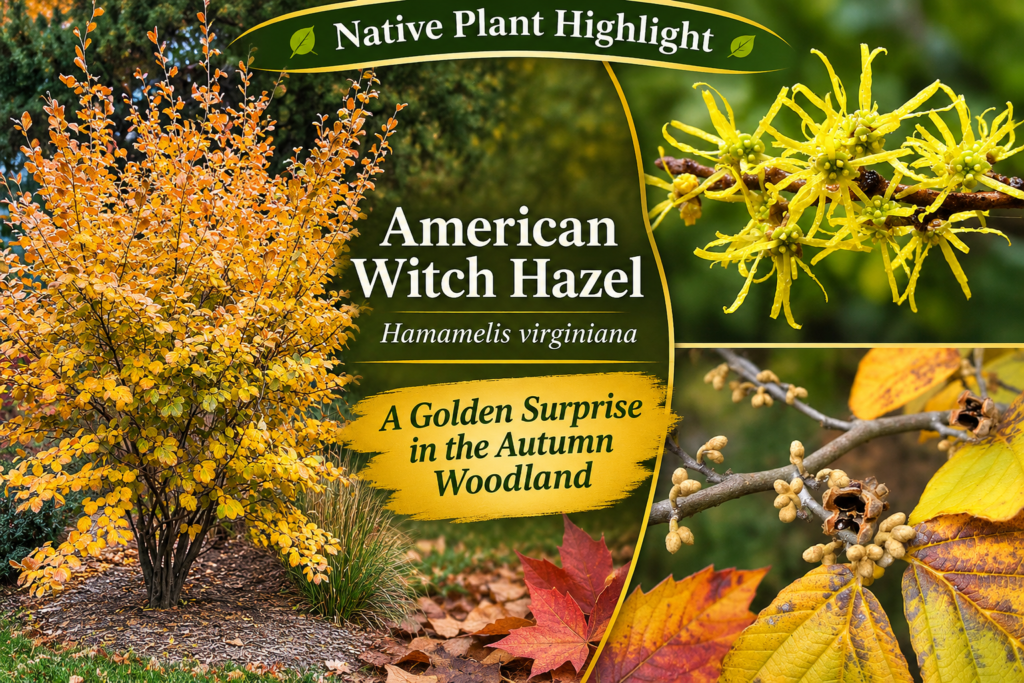
Just when the autumn leaves begin to fall and most wildflowers have finished blooming, a remarkable native shrub brings an unexpected splash of sunshine to the woodland landscape. Meet American Witch Hazel (Hamamelis virginiana), one of nature’s delightful late-season surprises!
With its delicate, golden-yellow, ribbon-like petals, this native woodland beauty reminds us that nature’s flowering season doesn’t necessarily end with summer.
🌼 Meet American Witch Hazel
Native to Georgia and much of eastern North America, American Witch Hazel is a deciduous shrub or small tree that thrives along woodland edges, in forest understories, and in naturalized gardens.
🌱 Plant Profile
- Scientific Name: Hamamelis virginiana
- Plant Type: Deciduous shrub or small tree
- Height: 15–30 feet
- Bloom Time: October–December
- Flower Color: Golden yellow
- Light Requirements: Full sun to partial shade
- Soil Preferences: Moist, well-drained, organically rich soil
- Habitat: Woodlands, forest edges, and streambanks
🐝 A Late-Season Pollinator Resource
While many insects are preparing for winter, American Witch Hazel provides nectar and pollen for some of the insects that remain active during mild autumn days.
Its unusual flowers may attract:
- Small native bees
- Flower flies
- Fungus gnats
- Late-season moths
- Other small insects
Its foliage also supports native moth caterpillars, including those of the stunning Witch Hazel Dagger Moth (Acronicta hamamelis).
These insect relationships help support the larger woodland food web, providing food for birds and other wildlife.
💥 Nature’s Tiny Catapult!
American Witch Hazel has a fascinating seed dispersal strategy known as ballistic seed dispersal.
As its woody seed capsules mature and dry, pressure builds inside until the capsules suddenly split open, launching their shiny black seeds several feet away from the parent plant.
Remarkably, its seeds develop over the course of nearly a year, meaning you may discover mature seed capsules alongside newly opened flowers on the same plant!
🍁 More Than Just Beautiful Flowers
American Witch Hazel contributes to healthy woodland ecosystems by:
🌿 Providing late-season floral resources for insects.
🐛 Supporting native caterpillars and other plant-eating insects.
🐦 Offering seeds, shelter, and foraging opportunities for wildlife.
🍂 Adding structural diversity to woodland understory habitats.
🌳 Contributing to a diverse, interconnected native plant community.
🏡 Bring American Witch Hazel Into Your Landscape
Consider incorporating this beautiful native shrub into your:
- Woodland garden
- Native shrub border
- Naturalized landscape
- Wildlife habitat garden
- Transitional area between lawn and woodland
Pair it with other native woodland plants such as Christmas Fern, Oakleaf Hydrangea, Northern Spicebush, and native woodland sedges to create a diverse habitat that supports wildlife throughout the year.
💡 Did You Know?
The name “witch hazel” is believed to be associated with an old English word meaning flexible or pliable, referring to its branches. Historically, forked witch hazel branches were also used as divining rods to search for underground water.
🔍 Your Nature Challenge
Take a walk through a woodland or native plant garden this week. Look beyond the fallen leaves and bare branches for the delicate golden flowers of American Witch Hazel.
Can you find its unusual ribbon-like petals, woody seed capsules, or visiting insects?
You might discover that autumn holds more surprises than you imagined!
💚 The Bigger Picture
Creating healthy wildlife habitat means thinking beyond spring and summer blooms. By incorporating native plants that flower, produce seeds, and provide shelter at different times of the year, we can help sustain wildlife through every season.
American Witch Hazel is a beautiful reminder that even as the woodland prepares for winter, nature’s living tapestry continues to unfold.
Plant Native. Support Wildlife. Celebrate Every Season.
🌿 Nature on the Brink
Inspiring the Next Generation of Environmental Stewards
Explore. Discover. Connect. Protect.
Photos: bloom: Maryland Biodiversity; tree: Iowa Extension; seeds: Clemson Extension
#NatureOnTheBrink #NativePlantHighlight #AmericanWitchHazel #HamamelisVirginiana #NativePlants #GeorgiaNativePlants #FallFlowers #AutumnWoodland #WoodlandGardens #NativeShrubs #PollinatorConservation #WildlifeHabitat #SeedDispersal #Biodiversity #PlantNative