
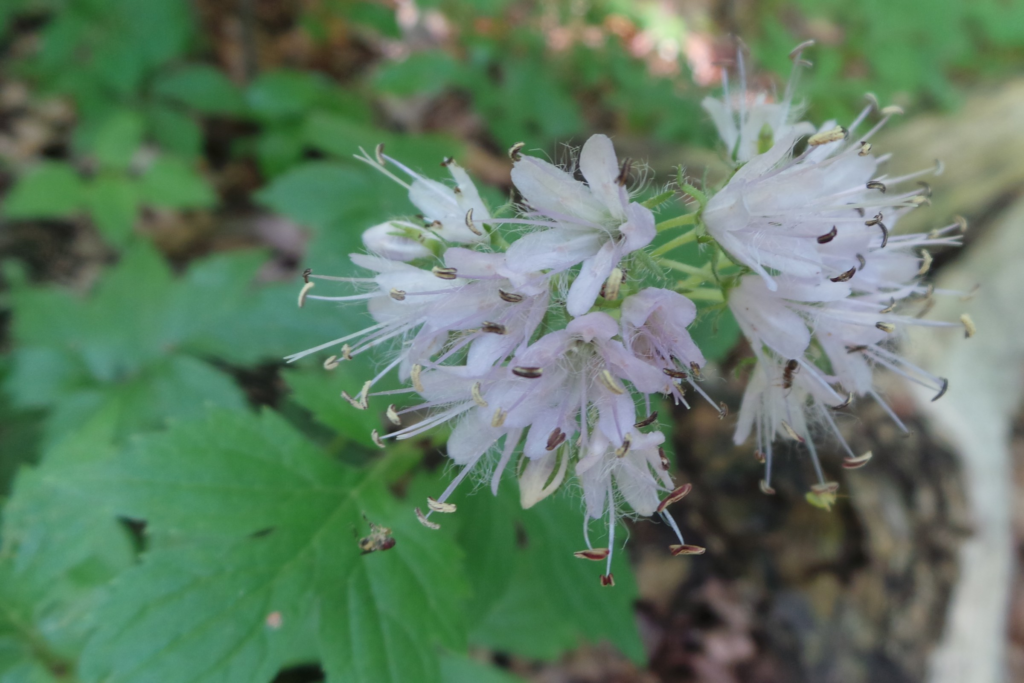
Walk through a rich Eastern woodland in spring and you may encounter a plant that is easy to overlook until you stop and look closely. Its broad green leaves appear to have been splashed with water, while delicate clusters of pale lavender to white flowers rise above the foliage.
This is Virginia Waterleaf (Hydrophyllum virginianum), a native woodland wildflower that demonstrates just how much beauty—and ecological value—can be tucked into the shady corners of our landscapes.
What’s in a Name?
Virginia Waterleaf gets its common name from the distinctive pale markings often visible on its young leaves. The mottling can resemble water stains or droplets that have dried on the foliage. As the leaves mature, these markings often become less noticeable.
The plant belongs to the borage family, Boraginaceae, a family that includes several other plants valued by pollinators.
Despite “Virginia” appearing in its name, Virginia Waterleaf isn’t limited to that state. It occurs across a considerable portion of eastern North America, typically inhabiting rich, moist deciduous forests, wooded slopes, floodplains, and streamside areas.
It is a plant adapted to life beneath the trees.
Spring Flowers for Hungry Pollinators
In spring, Virginia Waterleaf produces rounded clusters of small, bell-shaped flowers. Depending on the plant and growing conditions, the blossoms may range from nearly white to lavender or pale purple.
Look closely at an individual flower and another beautiful detail appears: the stamens extend noticeably beyond the petals, giving the flowers a soft, almost fuzzy appearance.
To us, the flowers are attractive.
To a hungry spring pollinator, they are something much more important: food.
Bees and other insects visit the flowers for nectar and pollen during a time of year when dependable floral resources are especially valuable. Bumble bees are among the conspicuous visitors you may find moving through a colony of blooming waterleaf.
That makes Virginia Waterleaf part of an important succession of native plants that provide food as pollinators become increasingly active in spring.
A Different Kind of Garden
Virginia Waterleaf also challenges a common idea about what a pollinator garden should look like.
When we hear “pollinator garden,” we often imagine a sunny meadow filled with coneflowers, milkweeds, mountain mints, asters, goldenrods, and blazing stars.
But pollinators need more than sunny gardens.
Woodlands are habitat, too.
The shaded spaces beneath deciduous trees support their own communities of plants and animals. Spring wildflowers take advantage of the sunlight reaching the forest floor before the tree canopy fully develops.
Virginia Waterleaf can be part of that woodland community.
In a home landscape, it can work especially well in woodland gardens and naturalized areas with moist, organically rich soil and partial to full shade. Once established in favorable conditions, the plant can spread through underground rhizomes and form colonies.
For gardeners accustomed to purchasing ornamental groundcovers, that spreading habit offers another possibility: allowing native plants to fill spaces where ecological function is just as important as appearance.
Think in Plant Communities
Virginia Waterleaf becomes even more interesting when we stop thinking about it as an individual specimen and begin thinking about a woodland plant community.
Imagine it growing beneath native trees and shrubs alongside other spring and woodland natives.
Rather than a garden composed of isolated ornamental plants surrounded by mulch, the landscape begins to resemble the layered structure of a natural ecosystem.
Trees form the canopy. Shrubs occupy the understory. Woodland wildflowers and sedges cover portions of the ground.
Each layer creates opportunities for wildlife.
The result doesn’t have to look wild or neglected. Native woodland gardens can be intentionally designed, with pathways, defined edges, repeated plant groupings, and other visual cues showing that the landscape is being cared for.
What changes is the purpose.
Instead of asking only, “What will look pretty here?”, we can also ask, “What can live here?”
Don’t Forget the Shady Parts of Your Yard
Many homeowners have a difficult shady corner where turfgrass struggles and sun-loving flowers refuse to bloom.
Our first instinct may be to add mulch or search for another ornamental groundcover.
But that difficult spot may actually be an opportunity.
If the soil and moisture conditions are appropriate, woodland natives can transform an underused area into habitat.
Virginia Waterleaf is particularly well suited to naturalistic landscapes where it has room to spread. Because colonies can expand when conditions are favorable, gardeners should consider where that behavior is desirable before planting it in a small, tightly controlled bed.
In the right location, however, its ability to spread can be an advantage rather than a problem.
Instead of maintaining bare mulch beneath trees, imagine a living layer of native vegetation.
A Plant That Tells a Bigger Story
Virginia Waterleaf will probably never have the instant name recognition of a monarch butterfly’s milkweed or the dramatic late-season display of goldenrod covered with insects.
But perhaps that’s part of what makes it worth knowing.
Conservation isn’t built around a handful of famous species.
Healthy ecosystems depend upon thousands of relationships involving plants, insects, birds, fungi, microorganisms, soil, water, and countless other organisms. Many of those relationships unfold quietly, unnoticed beneath our feet or under the shade of a tree.
Virginia Waterleaf reminds us that habitat doesn’t have to be spectacular to be important.
Sometimes it is a patch of spring wildflowers beneath a woodland canopy.
Sometimes it is a bee disappearing into a cluster of lavender flowers.
And sometimes restoring habitat begins simply by looking at the shady corner of our own yard and realizing that something native could be growing there.
Plant the woodland. Feed the pollinators. Restore the connections.
Photo: Wisconsin Horticulture – Universtiy of Wisconsin