What happens when a beautiful native wildflower provides more than just a meal?
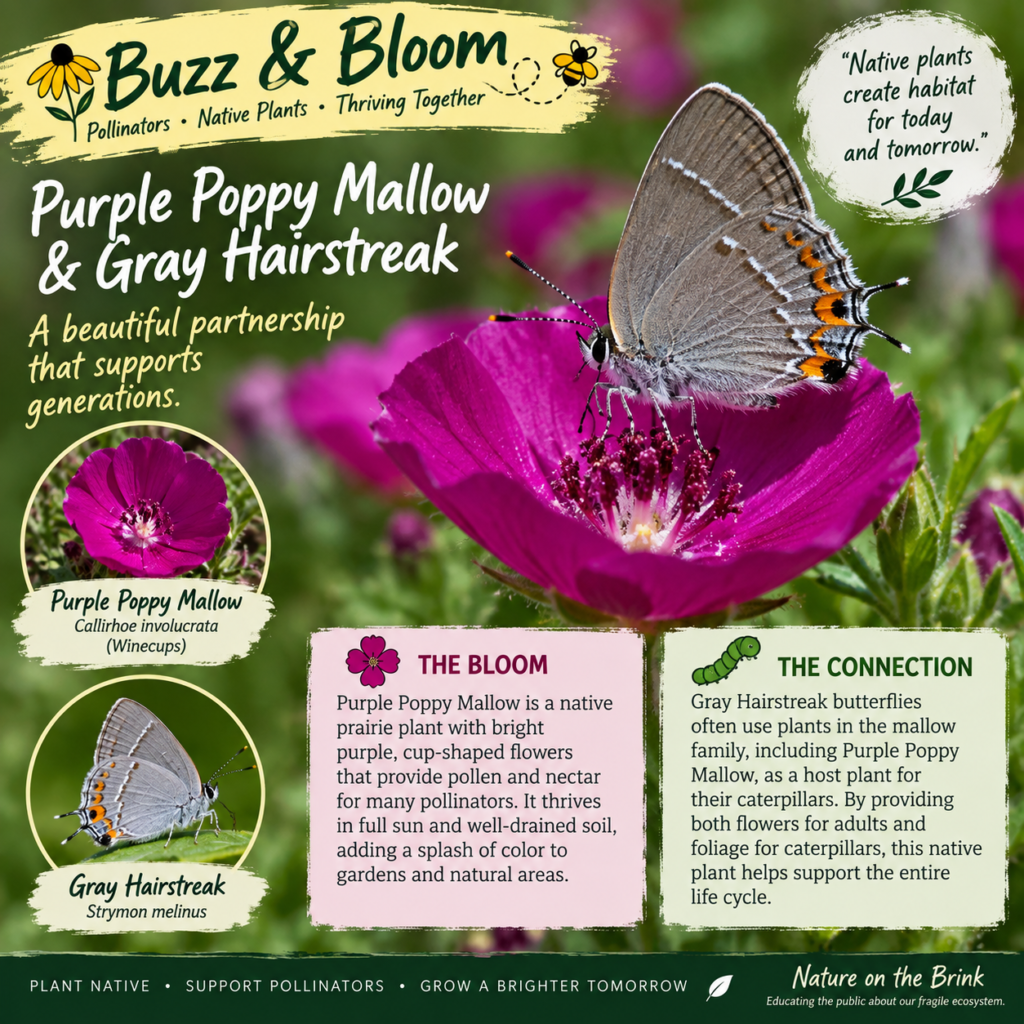
Meet Purple Poppy Mallow (Callirhoe involucrata), also known as Winecups, and one of the butterflies that can depend on plants in the mallow family—the Gray Hairstreak (Strymon melinus).
💜 THE BLOOM: Purple Poppy Mallow
With brilliant magenta-purple, cup-shaped flowers sprawling across the ground, Purple Poppy Mallow is hard to miss. This prairie native thrives in sunny, well-drained locations and provides pollen and nectar for visiting insects.
But its value doesn’t end when a butterfly leaves the flower.
🦋 THE BUZZ: Gray Hairstreak
The Gray Hairstreak is a small butterfly with an ingenious defense. Fine “tails” and markings near the back of its wings create a false head, complete with what appear to be tiny antennae.
When resting, the butterfly may move these tails, encouraging a predator to strike the less-vital rear portion of its wings rather than its actual head.
🐛 THE HOST-PLANT CONNECTION
Gray Hairstreak caterpillars can feed on an unusually wide variety of plants—including members of the mallow family such as Purple Poppy Mallow.
That means this native plant can play two roles in a pollinator garden:
🌸 Its flowers provide food for visiting adult pollinators.
🐛 Its foliage and reproductive structures can provide food for developing Gray Hairstreak caterpillars.
🌿 THAT’S WHAT HABITAT LOOKS LIKE
A pollinator garden shouldn’t simply provide flowers for adult butterflies. To support the entire life cycle, we also need plants where butterflies can lay eggs and caterpillars can eat and grow.
Planting native species such as Purple Poppy Mallow helps turn a beautiful garden into something much more important:
A place where the next generation can begin. 💜🐛🦋
🌸 Plant the bloom. Feed the caterpillar. Complete the connection.
#BuzzAndBloom #PurplePoppyMallow #GrayHairstreak #CallirhoeInvolucrata #StrymonMelinus #Winecups #HostPlants #NativeButterflies #NativePlants #PollinatorGarden #PlantNative #HabitatAtHome #NatureOnTheBrink