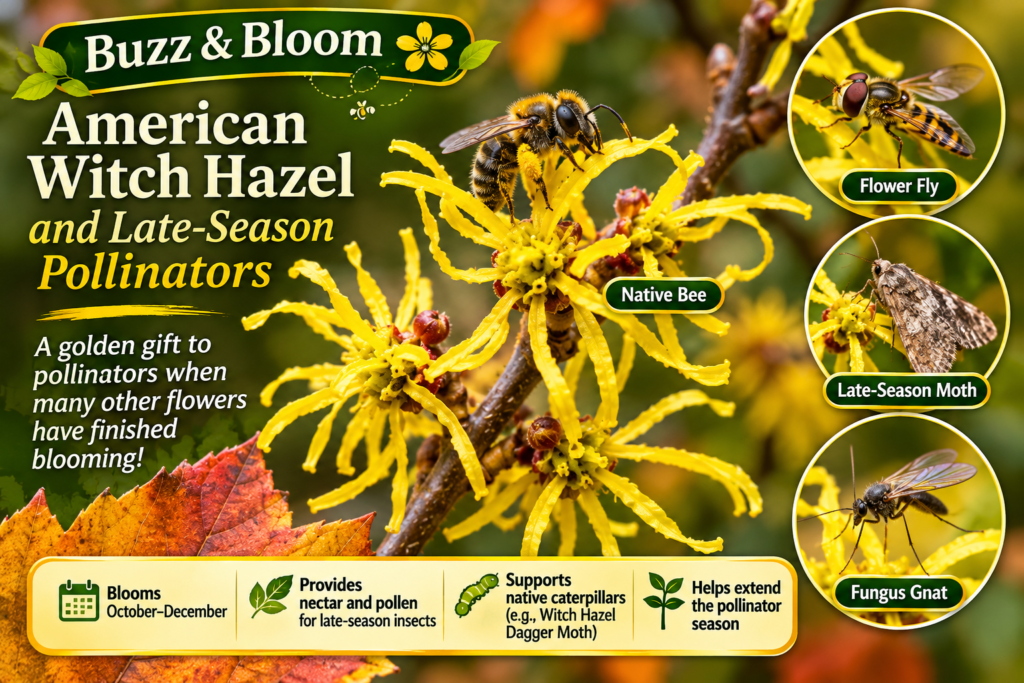
As autumn temperatures cool and the last of our native wildflowers fade, one remarkable woodland shrub is just beginning its floral display. American Witch Hazel (Hamamelis virginiana) bursts into bloom with delicate, golden-yellow, ribbon-like petals, offering a surprising source of floral resources for insects still active late in the season.
This week’s Buzz & Bloom celebrates the fascinating relationship between fall-blooming native plants and late-season pollinators!
🌼 The Bloom: American Witch Hazel
Unlike most native trees and shrubs, American Witch Hazel flowers in autumn, often continuing into early winter.
Native to Georgia and much of eastern North America, this beautiful woodland shrub provides a splash of golden color when many other plants are entering dormancy.
Its unusual flowering schedule makes it a fascinating addition to a landscape designed to support wildlife throughout the year.
🐝 The Buzz: Meet the Late-Season Pollinators
While many insects have entered their winter resting stages, others remain active during mild autumn days.
American Witch Hazel flowers may attract a variety of small insects, including:
- Small native bees: Searching for remaining sources of nectar and pollen.
- Flower flies: Visiting flowers for nourishment while potentially transferring pollen.
- Fungus gnats: Tiny insects that may participate in pollination.
- Late-season moths: Some cold-tolerant moths remain active when temperatures drop.
These often-overlooked insects remind us that pollination is not limited to butterflies and bees — and it doesn’t necessarily end with summer!
❄️ Nature’s Cold-Weather Specialists
Some native moths are remarkably well adapted to cooler temperatures.
Certain species, including moths known as winter moths or winter-active noctuid moths, can generate body heat by vibrating their flight muscles before taking flight.
This remarkable adaptation allows some moths to remain active when many other insects are unable to fly.
Late-blooming plants such as American Witch Hazel offer potential feeding opportunities for insects that venture out during these cooler months.
🐛 Beyond the Bloom: Supporting the Next Generation
American Witch Hazel’s ecological importance extends beyond its flowers.
Its leaves also provide food for native caterpillars, including the Witch Hazel Dagger Moth (Acronicta hamamelis), featured in this week’s Wildlife/Pollinator Spotlight.
From nourishing caterpillars during the growing season to offering flowers in autumn, American Witch Hazel demonstrates how a single native plant can support wildlife in multiple ways throughout the year.
🌱 Creating a Year-Round Pollinator Buffet
A successful pollinator garden provides a succession of blooms throughout the growing season.
Consider incorporating these native plants into your landscape:
🌸 Early Spring: Eastern Redbud and Northern Spicebush
🌼 Late Spring: Golden Alexander and native beardtongues
☀️ Summer: Bee Balm, Mountain Mint, and Blazing Star
🍁 Fall: Goldenrods, native asters, and American Witch Hazel
Together, these plants help create a more continuous supply of floral resources for insects with different seasonal activity patterns.
🏡 Five Ways to Support Late-Season Pollinators
- Plant fall-blooming natives. Include native asters, goldenrods, and American Witch Hazel.
- Leave the leaves. Preserve natural shelter for overwintering insects.
- Keep standing stems. Allow native plant stems and seed heads to remain through winter.
- Reduce pesticide use. Protect insects searching for food and preparing for winter.
- Plant for every season. Include a diversity of native trees, shrubs, and wildflowers with overlapping bloom periods.
💡 Did You Know?
American Witch Hazel’s flowers are adapted to cool autumn weather. Their narrow petals can curl inward during cold conditions and unfurl again when temperatures become more favorable.
Nature has remarkable ways of adapting to seasonal challenges!
🔍 Your Buzz & Bloom Challenge
On a mild, sunny autumn afternoon, visit a flowering American Witch Hazel or another late-blooming native plant.
Spend five to ten minutes quietly observing its flowers.
Can you spot a tiny bee, a flower fly, or another unexpected insect visitor?
Record the date, temperature, plant species, and insects you observe. Your discoveries may reveal just how much life remains active as winter approaches!
💚 The Bigger Picture
Pollinator conservation is not simply about planting more flowers — it’s about providing the right resources at the right times.
By including native plants that bloom early in spring and late into autumn, we help fill seasonal gaps in food availability and create more resilient habitats.
American Witch Hazel reminds us that even as the woodland prepares for winter, nature’s living tapestry continues to unfold.
Extend the Bloom. Support the Buzz. Protect Pollinators in Every Season.
🌿 Nature on the Brink
Inspiring the Next Generation of Environmental Stewards
Explore. Discover. Connect. Protect.
#NatureOnTheBrink #BuzzAndBloom #AmericanWitchHazel #HamamelisVirginiana #LateSeasonPollinators #NativePlants #NativeBees #NativeMoths #FlowerFlies #FallFlowers #PollinatorConservation #GeorgiaNativePlants #WildlifeHabitat #YearRoundHabitat #PlantNative