As autumn fades and winter approaches, nature has a colorful surprise waiting for curious explorers!
DO NOT EAT THE BERRIES YOU FIND! SOME BERRIES ARE POISONOUS! LOOK, DO NOT TOUCH!
While many plants have dropped their leaves and summer wildflowers have disappeared, some native trees and shrubs are displaying brilliant clusters of red, purple, blue, and white fruits.
These colorful treasures are more than beautiful decorations — they’re an important source of food for birds and other wildlife!
This week’s Explore Outdoors Nature Challenge invites children, families, and nature enthusiasts of all ages to head outside and discover the fascinating world of native winter berries.
Grab your nature journal, put on your walking shoes, and get ready for a Winter Berry Hunt!
🍒 Your Mission: Discover Nature’s Winter Buffet!
Visit your backyard, neighborhood, local park, woodland trail, or native plant garden.
Your challenge is to find at least three different plants displaying berries or other fruits.
Look carefully along woodland edges, near streams, in naturalized landscapes, and among native shrubs.
Some fruits may be bright and easy to spot, while others are hidden among evergreen branches.
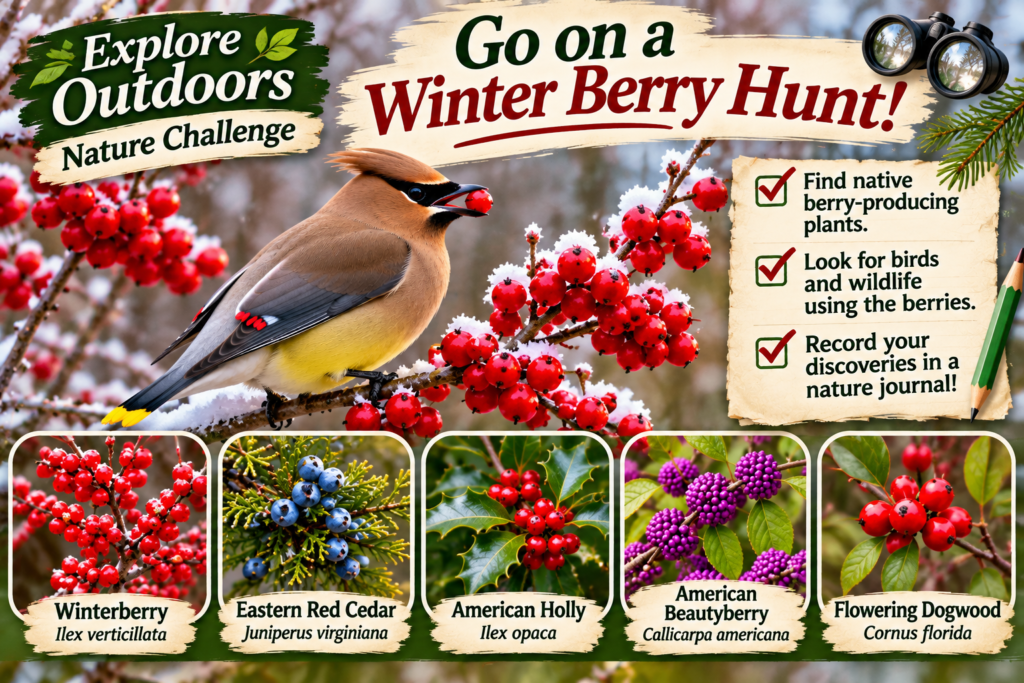
🔍 Five Native Plants to Look For
❤️ 1. Winterberry (Ilex verticillata) — The Brilliant Red Surprise!
Winterberry is a deciduous native holly that loses its leaves in autumn, revealing clusters of bright red berries along its bare branches.
These fruits may remain into winter, providing food for American Robins, Cedar Waxwings, and other birds.
Look for: Bright red berries clustered along leafless branches, especially in moist habitats.
💙 2. Eastern Red Cedar (Juniperus virginiana) — The Blue Winter Buffet!
Eastern Red Cedar is actually a native juniper!
Female plants produce small, blue, berry-like cones that provide valuable food for Cedar Waxwings and other wildlife.
Its dense evergreen foliage also offers shelter from winter weather.
Look for: Blue, waxy-looking cones nestled among evergreen, scale-like foliage.
❤️ 3. American Holly (Ilex opaca) — The Evergreen Classic!
American Holly is one of our most recognizable native evergreens.
Female trees can produce clusters of red fruits that contrast beautifully with their glossy, spiny leaves.
These fruits may persist into winter and provide food for birds.
Look for: Bright red berries among dark green, prickly evergreen leaves.
💜 4. American Beautyberry (Callicarpa americana) — Nature’s Purple Jewels!
American Beautyberry produces spectacular clusters of vivid purple fruits wrapped around its stems.
The fruits are eaten by birds and other wildlife, although they may disappear before the coldest part of winter.
Look for: Dense clusters of purple fruits along arching branches, sometimes remaining after the leaves have fallen.
❤️ 5. Flowering Dogwood (Cornus florida) — The Autumn Wildlife Feast!
Flowering Dogwood produces clusters of bright red fruits that are especially valuable to birds during late summer and autumn.
These fruits are often eaten before winter arrives, but you may still find some in early winter.
Look for: Small clusters of shiny red fruits on trees with distinctive opposite branching.
🐦 Become a Winter Wildlife Detective!
Finding berries is only the beginning!
Once you’ve discovered a fruit-producing plant, spend a few quiet minutes observing it.
Ask yourself:
🍒 What color are the fruits?
🌿 Are they growing in clusters or individually?
🌳 Is the plant evergreen or deciduous?
🐦 Are birds visiting the plant?
🐾 Can you find evidence that wildlife has been feeding there?
🍂 What other food or shelter resources are nearby?
You might discover a Cedar Waxwing feeding on berries, an American Robin searching for fruit, or a Northern Mockingbird defending a favorite food source.
Remember, even if you don’t see wildlife during your visit, the fruits may still provide important food later.
📓 Create Your Winter Berry Field Journal
For each plant you discover, record:
- Plant Name: Identify it if possible.
- Berry Color: Red, blue, purple, white, or another color?
- Plant Type: Tree, shrub, or vine?
- Leaf Type: Evergreen or deciduous?
- Habitat: Woodland, garden, wetland, or neighborhood?
- Wildlife Observed: Birds, insects, or other animals?
- Sketch or Photograph: Capture your discovery!
If you’re unsure of a plant’s identity, photograph its fruits, leaves, bark, and overall growth form.
Use a field guide or iNaturalist to help identify it.
🌱 Bonus Challenge: Follow the Seeds!
Did you know that many birds help native plants spread their seeds?
When a bird eats a fruit, some seeds may pass through its digestive system and be deposited in another location.
This process is called seed dispersal.
Imagine a Cedar Waxwing eating a Winterberry fruit in one woodland and later depositing a seed somewhere else.
That bird may help a new Winterberry plant establish!
During your berry hunt, think about how the plants you discover might depend on wildlife to spread their seeds.
🏡 Five Ways to Help Winter Wildlife
1. Plant Native Berry-Producing Trees and Shrubs.
Choose species suited to your local growing conditions that provide fruits across different seasons.
2. Preserve Existing Native Plants.
Before removing an unfamiliar shrub or tree, identify it. It may be an important wildlife food source.
3. Leave Berries for Wildlife.
Avoid harvesting wild fruits for decorations when they could provide food for birds.
4. Create Layered Habitat.
Combine native trees, understory shrubs, grasses, and wildflowers to provide food and shelter.
5. Share Your Discoveries.
Encourage friends, neighbors, and family members to learn about the native plants supporting wildlife in their communities.
⚠️ Winter Berry Hunt Safety!
🔴 Look, photograph, and observe — but never taste unidentified berries! Some fruits can be toxic to people and pets.
🌿 Avoid handling unfamiliar plants, especially those with irritating sap, thorns, or poisonous foliage.
🐦 Observe wildlife from a respectful distance.
🍒 Leave fruits and seeds in place for wildlife.
🌱 Be aware that some invasive plants also produce colorful berries. Not every berry-producing plant is native or beneficial to local ecosystems.
Children should explore with adult supervision.
🌟 Make It a Family Nature Adventure!
Turn your Winter Berry Hunt into a fun outdoor scavenger hunt!
Can you find:
☐ A plant with red berries
☐ A plant with blue or purple fruits
☐ An evergreen tree or shrub with fruit
☐ A deciduous shrub with berries on bare branches
☐ A bird feeding on berries
☐ Two different kinds of fruits
☐ A plant providing both food and shelter
☐ Three native berry-producing plants
Bonus: Identify a native plant you would like to add to your own wildlife-friendly garden!
💚 The Bigger Picture: Nature’s Living Tapestry
The relationship between native berries and winter wildlife reminds us that nature’s connections continue throughout every season.
Spring flowers support native bees and other pollinators.
Summer brings developing fruits and growing wildlife families.
Autumn offers an abundance of seeds and berries.
Winter reveals the importance of plants that provide food and shelter when resources may be harder to find.
From Winterberry’s brilliant red fruits to the Cedar Waxwing’s remarkable appetite for berries, every discovery helps us understand how plants and wildlife depend on one another.
Your Winter Berry Hunt is more than a scavenger hunt — it’s an opportunity to discover the hidden connections that keep our ecosystems thriving!
🍒🐦 Ready to Explore?
Head outdoors, discover nature’s colorful winter treasures, and share your favorite berry photograph or wildlife observation in the comments!
How many different native berry-producing plants can you find?
🌿 Nature on the Brink
Inspiring the Next Generation of Environmental Stewards
Explore. Discover. Connect. Protect.
#NatureOnTheBrink #ExploreOutdoors #NatureChallenge #WinterBerryHunt #Winterberry #NativeBerries #WinterWildlife #CedarWaxwing #BirdFriendlyGardens #NativePlants #GeorgiaNativePlants #OutdoorLearning #NatureScavengerHunt #FamilyNatureActivities #WildlifeHabitat #NatureJournal #Biodiversity #PlantNative