When we think of a healthy forest, we often picture towering oaks, majestic tulip poplars, and other magnificent canopy trees. But beneath those towering giants lies another incredibly important layer of life — the woodland understory.
Native understory trees and shrubs provide essential food, shelter, nesting sites, and breeding habitat for countless species of insects, birds, mammals, and other wildlife.
Without this vital layer, nature’s living tapestry would be missing many of its most important threads!
🌳 Understanding the Layers of a Forest
A healthy woodland contains several interconnected layers:
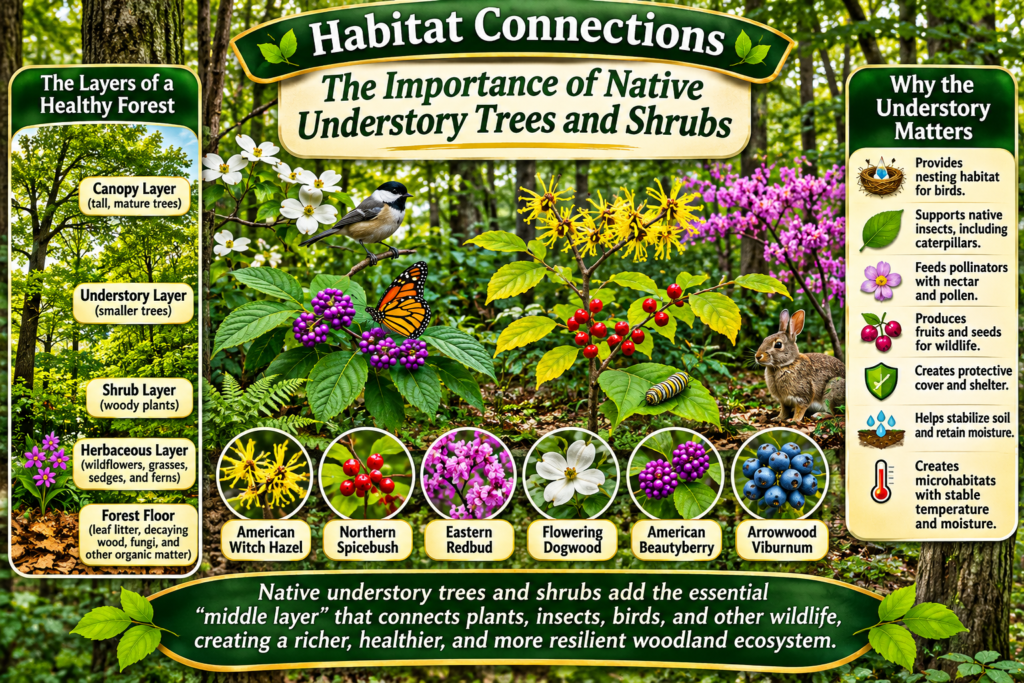
- Canopy Layer: Tall, mature trees that capture sunlight and provide habitat high above the ground.
- Understory Layer: Smaller trees growing beneath the canopy.
- Shrub Layer: Woody plants that provide food, shelter, and nesting opportunities closer to the ground.
- Herbaceous Layer: Wildflowers, grasses, sedges, and ferns.
- Forest Floor: Fallen leaves, decaying wood, fungi, and other organic materials that support decomposition and nutrient cycling.
Each layer provides unique resources, creating a diverse, three-dimensional habitat.
🐛 Native Understory Plants: A Wildlife Buffet
Native understory trees and shrubs support an incredible variety of wildlife through their flowers, leaves, fruits, seeds, and branches.
Consider these remarkable native plant relationships:
🌼 American Witch Hazel (Hamamelis virginiana) — Provides late-season flowers and serves as a host plant for the Witch Hazel Dagger Moth.
🦋 Northern Spicebush (Lindera benzoin) — Supports Spicebush Swallowtail caterpillars and produces nutritious fruits for birds.
🌸 Eastern Redbud (Cercis canadensis) — Provides early-season floral resources for native bees and other insects.
🐦 Flowering Dogwood (Cornus florida) — Produces fruits that feed numerous bird species and other wildlife.
💜 American Beautyberry (Callicarpa americana) — Offers clusters of brilliant purple fruits that provide food for birds and mammals.
🌿 Arrowwood Viburnum (Viburnum dentatum) — Provides flowers for pollinators, fruits for wildlife, and dense branches for shelter and nesting.
🌱 Why the Understory Matters
Native understory trees and shrubs contribute to healthy ecosystems by:
🐦 Providing nesting habitat: Dense branches offer protected locations for birds to build nests and raise their young.
🐛 Supporting native insects: Leaves provide food for caterpillars and other plant-eating insects that help sustain woodland food webs.
🦋 Feeding pollinators: Flowers provide nectar and pollen throughout different seasons.
🍒 Providing seasonal food: Fruits and seeds nourish birds and mammals, particularly during fall migration and winter.
🦊 Creating protective cover: Dense vegetation provides wildlife with places to hide, rest, and escape predators.
🌧️ Protecting soil: Roots help stabilize soil, reduce erosion, and support water infiltration.
🌡️ Creating microhabitats: Understory vegetation helps moderate temperature, moisture, and wind conditions.
⚠️ The Missing Middle
Many residential landscapes contain mature trees surrounded by expanses of lawn. Although these trees provide valuable habitat, the absence of native understory trees and shrubs creates a significant gap in the ecosystem.
Invasive plants such as Chinese Privet, Japanese Honeysuckle, and Autumn Olive can also crowd out native understory vegetation, reducing the diversity of resources available to wildlife.
Restoring this missing middle can transform an ordinary landscape into a thriving wildlife sanctuary.
🏡 Five Ways to Restore Your Woodland Understory
- Plant native understory trees. Consider American Witch Hazel, Eastern Redbud, Flowering Dogwood, or native serviceberries.
- Add native shrubs. Incorporate Northern Spicebush, Oakleaf Hydrangea, American Beautyberry, and native viburnums where growing conditions are suitable.
- Remove invasive plants. Gradually replace invasive shrubs and vines with diverse native vegetation.
- Reduce lawn beneath trees. Create naturalized planting areas filled with native shrubs, ferns, sedges, and woodland wildflowers.
- Preserve the forest floor. Leave fallen leaves and appropriate amounts of dead wood to support overwintering insects, decomposers, and soil health.
🔍 Your Habitat Challenge: Find the Missing Layer!
Take a walk around your yard, neighborhood, or local park.
Look for the different layers of vegetation:
- Are there tall canopy trees?
- Are smaller native trees growing beneath them?
- Are there dense shrubs providing wildlife shelter?
- Are native wildflowers, ferns, and sedges present?
- Is the forest floor covered with natural leaf litter?
Which layer is missing or could be improved?
Identify one location where adding a native understory tree or shrub could help create a more complete wildlife habitat.
💚 The Bigger Picture
Healthy habitats are about more than the number of plants we grow — they are about the diversity of life those plants support and the connections they create.
From the Witch Hazel Dagger Moth caterpillar feeding on American Witch Hazel to the songbird searching for insects among its branches, native understory plants help weave together the intricate relationships that sustain our woodland ecosystems.
By restoring the layers of our landscapes, we restore the connections that make nature thrive.
Think Beyond the Canopy. Restore the Understory. Reconnect Nature’s Living Tapestry.
🌿 Nature on the Brink
Inspiring the Next Generation of Environmental Stewards
Explore. Discover. Connect. Protect.
#NatureOnTheBrink #HabitatConnections #NativeUnderstory #NativeTrees #NativeShrubs #WoodlandHabitat #AmericanWitchHazel #NativePlants #GeorgiaNativePlants #WildlifeHabitat #HabitatRestoration #WoodlandGardens #Biodiversity #LivingTapestry #PlantNative